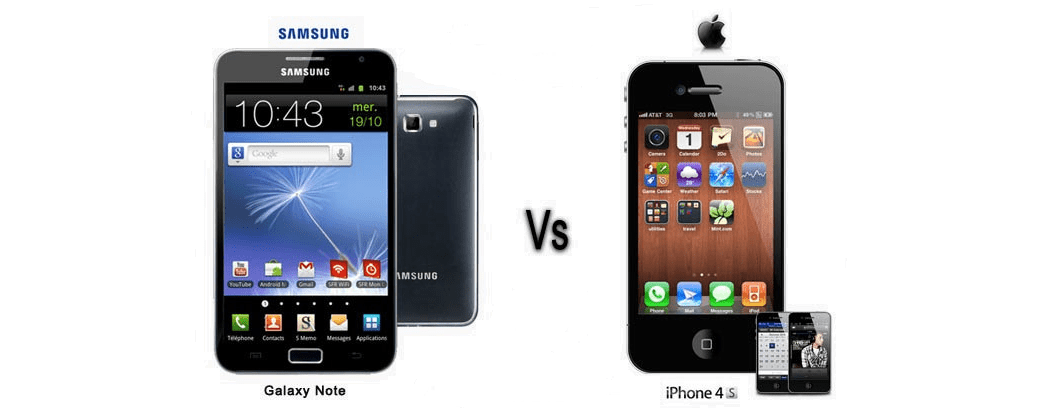
I am appalled by a billion dollar judgment brought against the Samsung company by Apple Computer Inc.? How can a company can make such a huge mistake, infringing upon the patents of another company. I question: was it a mistake?

Was it a miscalculation on the part of Samsung? The enormous amount of money spent in litigation concerning this patent infringement (and many others like it) is staggering. Would not — or could not — this money be put to better use? I think something is wrong with the patent system. I wonder if we got the ethics wrong; I wonder whether the patent system is out of step with the times.
The economic prosperity brought by the information age cannot be disputed. Advances in computing technology have brought forth a society where information is available to everyone at the click of a mouse button. Computers, and the software that controls them, are an innovation that keeps on giving. Many corporations, companies, and individuals have prospered because of this innovation. The ideas and expressions of many an engineer has brought this age into being, and continues to spark creativity. Intellectual property protection helps to make sure those who create have the opportunity to enjoy the profits brought forth by their creations. The individuals and organizations that spend resources developing innovation have the opportunity to recoup their investments.
Patents are Ethical
Innovation is good! Society benefits from innovation! Utilitarianism tells us that if the utility of an action increases happiness and well being for a majority of people, then that act is a good one[1, p. 29].  Innovation is good because it has helped to bring about much well being. Be it creating a process that cleans clothes, or designing a device that enables a once-disabled person to walk again, innovation can bring much happiness into our lives. “It is desirable and in the public interest[2, p.7]”. If innovation is good, then patents are good. Patents are good because they create an environment where people are more likely to innovate. People are more likely to innovate when they have a better chance of prospering from their innovations.
 Given that innovation is good, and patents are good, it would be bad/wrong to infringe on patents. Companies should respect the expressions created by others, and expect to be respected also. A good company should review the patents created by others without fear (because they are there to be viewed), learn from them, license them when desired, and eventually innovate anew.
Questionable Ethics – Case in Point:
So with this simple understanding of what is right and wrong, why is it hard to adhere to these principles, and why do companies resort to the behaviors that they do? Case in point: Samsung Electronics Co., Ltd. vs. Apple Computer Inc. This lawsuit has been dragging on for three years. Apple alleged that Samsung infringed upon a number of its patents regarding smart phones, and the software on them. Apple alleges that Samsung infringed upon the its patents (see Apple Patents). In a counter suit, Samsung alleges that Apple infringed upon its patents[8](see Samsung Patents). Many judgments have been rendered in the last three years, with wins and losses on both sides. Samsung seems to have borne the brunt of the judgment, though, with a loss, and requested payment of damages to the tune of $1.049 billion dollars (later reduced to $400 million). That, however, was not a final judgment. The case is still ongoing, with yet another judgment to come shortly. So called “Look and Feel” cases, like this one, appeared as early as 1987, Lotus Dev. Corporation v. Paperback Software International[3, 41].
Note: There are many other cases of this nature. In some circles, these have become known as the “Smartphone patent wars” [7]. They involve well known companies like Samsung, Apple, Microsoft, Google, Nokia, HTC, Oracle, etc…
Questionable Ethics – Case 2:

What happens when the reason for holding a patent is to intentionally stifle innovation? If the innovation is something that would majorly benefit the community, then the ethical stance as goes utility for the community is obvious. It is wrong to buy a patent in order to squelch the innovation that could benefit us all. This situation may not rise often in software but given the nature of patent law, it is nonetheless possible.
Bad Ethics – Wasted Resources
 Litigation, however necessary to combat patent infringements, is a waste of resources. One would think that for a billion dollars, a company would not have any trouble innovating. I don’t think this is simply a matter of unethical people not practicing innovation? I think the problem is:
1) Technologies (i.e software) that are not well-suited to patent law.
2) A highly competitive landscape in which companies compete in disheartening ways.
Software is a technology that is often hard to create, but easy to imitate. It is prone to piracy[4, Chpt. 1]. It is sometimes hard to judge whether the thing that is being created (or imitated) is something that is new and unique, and thus worthy of a patent, or just something that shares functional similarities. There has often been criticism to the granting of patents. Some think the granting of patents is too easy. They complain that there is not enough oversight or good judgment that goes into what should be patented. The fact is, patent offices are being overwhelmed by vast numbers of applications for patents. This push to patent is being caused by the second problem mentioned.
 Competition is not new. Patent law was created with competition in mind. But organizations these days are competing on many fronts. What was once just a technological contest has now become a legal, economical, and political contest. There are billions of dollars at stake. Competitors are using every tool available to them. If hijacking the patent process is what gives a competitor, a competitive edge, then the patent, once considered a tool for fostering innovation, is fair game to be used as a weapon of war.
Innovation is happening in the presence of changing laws. What one day was an idea or an expression, the next day might be considered a functional aspect. The law is not solid in this respect. Some cases are setting precedent, but the law suits continue.
My Opinion
It is not always evident what the best answer is for a complex problem, and patent law and enforcement is a complex problem. The granting of monopolies (patents) to organizations is a serious endeavor. Granting patents demands that serious attention be given in proper measure to each patent. It’s evidenced by the backlog in patent applications, that patent offices need more resources; those resources should be highly qualified professionals. Change also needs to happen in the realm of the law. The continual granting of patents at such an alarming rate is worrisome. We could get to a place where it becomes almost impossible to innovate without tripping over a patent. Innovation would be stifled. This would be the opposite of utility. We must recover the patent process from the would-be hijackers. The owners of patents should be required to do something good with them (license-wise). Reluctant patent holders might be subjected to compulsory licensing as a remedy in such cases[2, p.145] [5, p.37] [6, p.195]. Many times, patent infringement cases are settled before getting to the courts, and perhaps more can be done to shore up this process. If these systemic changes could be made, innovation may be freed, and society would be the winner, with cheaper cell phones and more innovation for all.
Patents
The following patents were involved in the Samsung Electronics Co., Ltd. vs. Apple Computer inc. lawsuit:
Apple Computer Inc. Patents
- US 7,469,381: List Scrolling and Document Translation, Scaling, And Rotation on a Touch-Screen Display (Dec. 23, 2008)
- US 7,844,915: Application Programming Interface for Scrolling Operations (Nov. 30, 2010)
- US 7,864,163: Portable Electronic Device, Method, and Graphical User Interface for Displaying Structured Electronic Documents (Jan. 4, 2011)
- US D504,889: The ornamental design for an Electronic Device. (May 10, 2005)
- US D593,087: The ornamental design for an Electronic Device. (May 26, 2009)
- US D618,677: The ornamental design for an Electronic Device. (June 29, 2010)
- US D604,305: Graphical User interface for a Display Screen or Portion Thereof. (Nov. 17, 2009)
Samsung Electronics Co. Ltd. Patents
- US 7,675,941: Method and Apparatus for Data Transmission/Receiving Packet Data Using Pre-Defined Length Indicator in a Mobile Communications System. (Mar. 9, 2010)
- US 7,447,516: Method and Apparatus for Data Transmission in a Mobile Telecommunication System Supporting Enhanced Uplink Service. (Nov. 4, 2008)
- US 7,698,711: Multi-tasking Apparatus and Method in Portable Terminal. (Apr. 13, 2010)
- US 7,577,460: Portable Composite Communication Terminal for Transmitting/Receiving and images, and Operation Method and Communication System Thereof. (Aug. 18, 2009)
- US 7,456,893: Method of Controlling Digital Image Processing Apparatus for Efficient Reproduction and Digital Image Processing Apparatus Using the Method. (Nov. 25, 2008)
- US 6,847,959: Universal Interface for Retrieval of Information in a Computer System. (Jan. 25, 2005))
Bibliography
[1] Sara Baase. A Gift of Fire Social, Legal, and Ethical Issues for Computing Technology Fourth Edition.
Pearson Education inc., and Prentice Hall, Upper Saddle River, NJ. 2013, 2008, 2003
[2] Editor World Intellectual Property Organization (WIPO). Introduction to Intellectual Property Theory and Practice
Kluwer Law International. Cambridge, MA. 1997
[3] Anthony Lawrence Clapes. Softwars The Legal Battle For Control of the Global Software Industry.
Quorum Books, Westport, CN. 1993
[4] Adrian Johns. Piracy the Intellectual Property Wars From Gutenberg to Gates.
The University of Chicago Press, Chicago, IL. 2009
[5] Francois Leveque and Howard Shelanski. Antitrust, Patents and Copyright
Edward Elgar Publishing Limited UK, Edward Elgar Publishing Inc. Massachusetts, 2005
[6] Irma Haracoglou. Competition Law and Patents A Follow-on Innovation Perspective in the Biopharmaceutical Industry. Edward Elgar Publishing Limited UK, Edward Elgar Publishing Inc. Massachusetts, 2008
[7] Wikipedia. Apple vs Samsung: The next battle in their patent wars. http://en.wikipedia.org/wiki/Smartphone_wars/ (Last Modified Apr 23, 2014)
[8] By Quentin Tannock on July 31, 2012. Apple vs Samsung: The next battle in their patent wars. http://cambridgeip.com/2012/07/31/apple-vs-samsung-the-next-battle-in-their-patent-wars/
 PDX KPOP